
University Access Dashboard - Home
Holding Our Universities Accountable for Their Access Commitments
The UAEM Access Dashboard advances global health equity by evaluating university technology transfer practices and their implications for access to publicly-funded health technologies.
7 Previous Report Cards
30 Universities Assessed
Evaluated Across 8 Metrics
WHAT IS THE UNIVERSITY ACCESS DASHBOARD?
About the University Access Dashboard
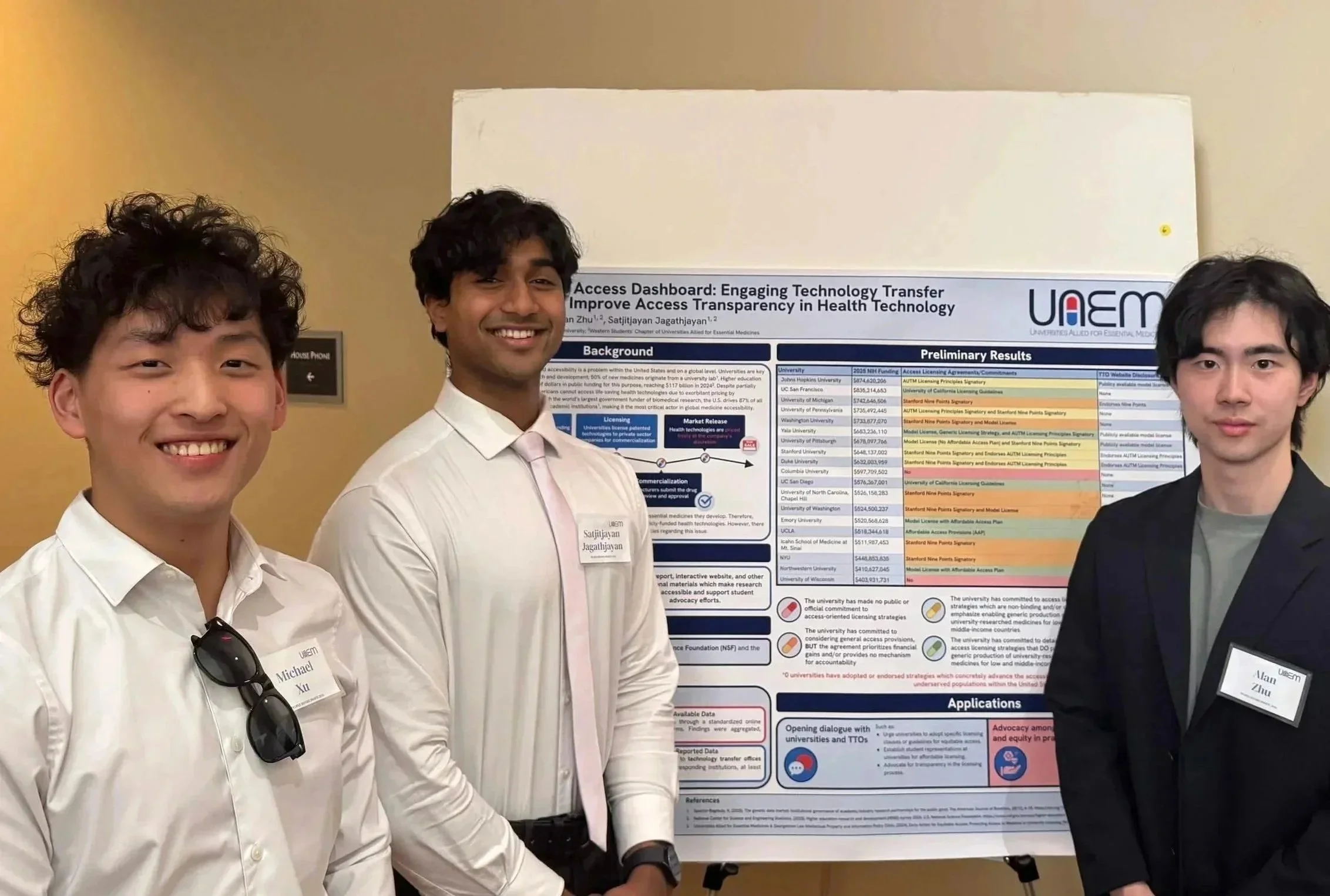
A project of Universities Allied for Essential Medicines, the University Access Dashboard is a comprehensive assessment designed to evaluate biomedical innovation and technology access policies at academic research institutions. Researchers compile publicly available data and survey universities directly, combining both into each institution's score.
HOW DOES IT WORK?
How to Use the Access Dashboard
Search for your university to see how it scores across all access metrics. Click “Learn more” to view each underlying question and data. Use the compare feature to see how your institution measures up to its peers. Consider what you find and use it in your university access campaign.
WHY DOES IT MATTER?
Significance of Transparency in University Licensing
Higher education institutions receive billions of dollars in public funding to conduct biomedical research, yet the health technologies they develop often end up in the hands of corporations who prioritize profit over public health need. As a result, when a health technology that began in a university lab reaches the market, it is often inaccessible to patients due to monopoly pricing and other access barriers. Universities are positioned to influence these outcomes through the terms of their licensing agreements. By bringing greater transparency to university licensing practices, the University Access Dashboard provides an accountability tool to ensure universities are doing their part in addressing the access to medicines crisis.

Access to medicines
Access-oriented licensing terms can support access to publicly-funded health innovations for populations in low- and middle-Income countries and other populations with health disparities.
Return on public investment
Universities that receive public research funding have a responsibility to ensure the resulting health technologies remain accessible. The dashboard assesses the degree to which institutions fulfill this obligation.
Institutional accountability
By centralizing and standardizing data on licensing practices, the dashboard creates a basis for peer comparison among institutions and supports advocacy efforts to hold universities accountable for their access policies and practices.
Addressing information gaps
There is a significant lack of centralized, publicly accessible information on university licensing policies. The dashboard addresses this gap and provides resources for advocates, researchers, and the public.
TESTIMONIALS FROM PAST REPORT CARDS
“The University Report Card helps illuminate the effects of academic biomedical research on the health of the world’s poor, and hold universities accountable for the impact, or lack of impact, that their policies have on global health. I am grateful to the students of UAEM for creating the scorecard, and strongly encourage students, faculty, and broader university communities to call on their institutions to enact policies that increase access to lifesaving medicines and medical technologies for those who need them most.”
2020 UAEM Report Card
— Dr. Paul Farmer, Founder of Partners in Health
“Canadian Universities play a critical role in addressing global challenges such as HIV/AIDS, Tuberculosis, and other neglected diseases. It is imperative that we continue to give priority to the lives of millions through licensing practices that allow our world-class research to reach those that need it most. This Report Card helps us measure the impact our universities have on global health. It clearly shows Canadian Universities are falling short: students, faculty and related communities must jolt the Universities into sanity.”
2017 UAEM Report Card
— Stephen Lewis, Co-Director of AIDS-Free World, Canada’s Former Ambassador to the United Nations
“We are delighted that UAEM has chosen to promote access to vaccines through the mechanism of the Open COVID Pledge, a lightweight and enforceable legal framework for making intellectual property available in combating the COVID-19 pandemic. The ethos of IP sharing that is embodied in the Pledge can help to alleviate the enormous human suffering that continues to emerge from this public health emergency.”
2020 UAEM Report Card
— Jorge L. Contreras, Professor, S.J. Quinney College of Law, University of Utah
“The UAEM Canadian Global Equity in Biomedical Research Report highlights a worrying lack of transparency on publicly funded biomedical research carried out by Canadian Universities. With only a third of clinical trials data disclosed and only one university adopting global access licensing, this Report card proves once again that universities have a long way to go. It is time for universities to fulfill their responsibility to ensure that publicly funded biomedical research is available for the public good.”
2017 UAEM Report Card
— Rachel Kiddell-Monroe, ISID Professor of Practice McGill University