Friend,
UAEM has had a busy spring – from a landmark conference at UCLA to a new five-year strategic plan – and we’re excited to share it all with you. Summer is here and universities are on break, but UAEM’s advocacy won’t stop. Students across our community will keep speaking out and pushing for progress where it matters the most. Enjoy our spring recap.
Onward,
UAEM Communications Committee
|
People Before Profit: Advancing an Equitable Health Future
|
From April 3–5, 2026, students, researchers, advocates, and policy experts convened at UCLA for the annual UAEM North American Conference: People Before Profit: Advancing an Equitable Health Future. At a pivotal moment for global health equity, marked by rising drug costs, threats to research funding, and renewed debates around intellectual property, attendees engaged in panels, workshops, and discussions that challenged existing systems while equipping participants with tools to drive meaningful change. Highlights included a keynote on global access to lenacapavir featuring Dr. Wesley Sundquist alongside advocates from Public Citizen, AIDS Healthcare Foundation, and MSF; a plenary from Alex Moss of the Public Interest Patent Law Institute on reimagining patents for the public good; and sessions spanning Public Pharma, health justice, socially responsible licensing, and neglected disease advocacy. The weekend closed with a poster session awards ceremony and a panel from UAEM's Coordinating Committee on student involvement across the North American network.
|
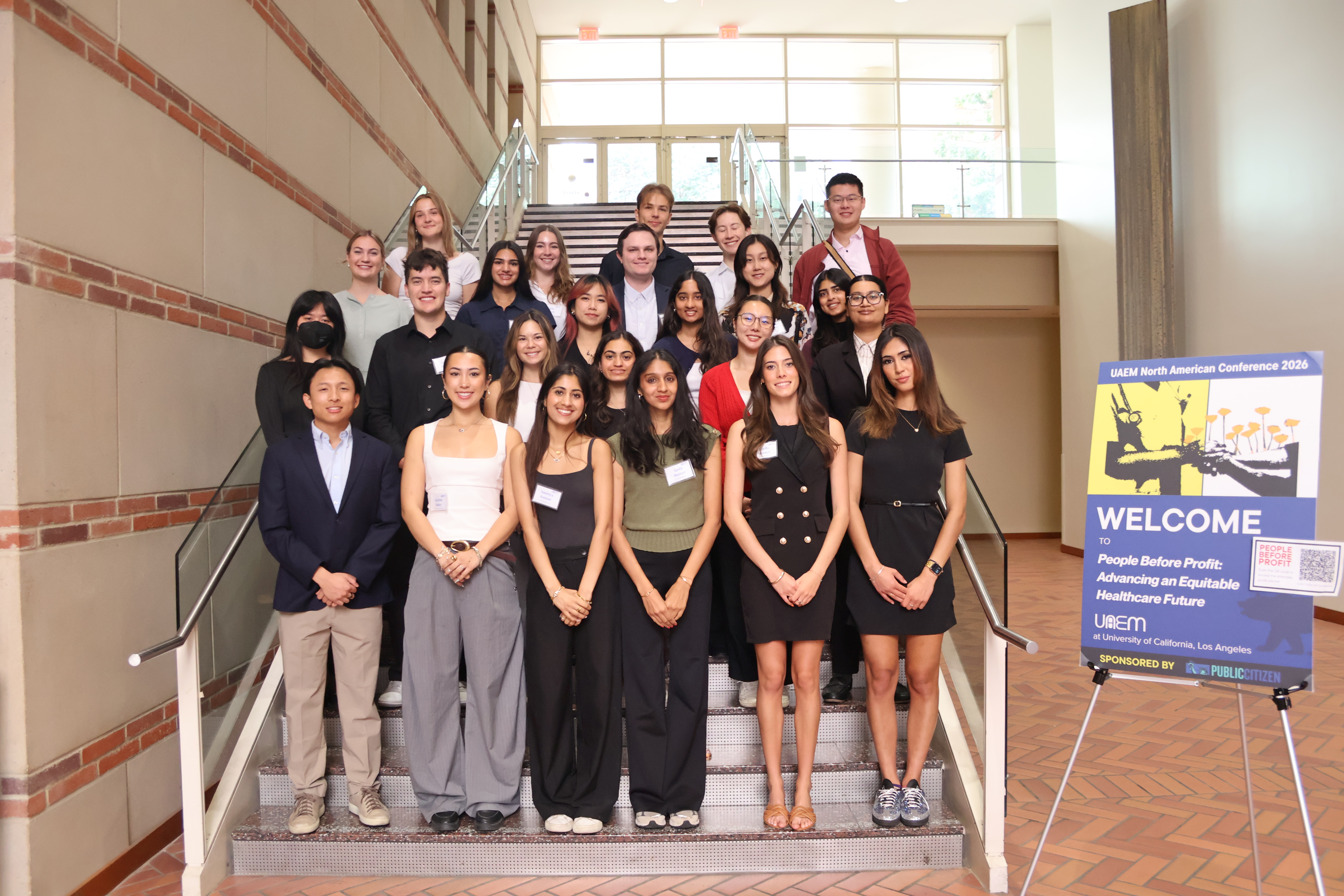
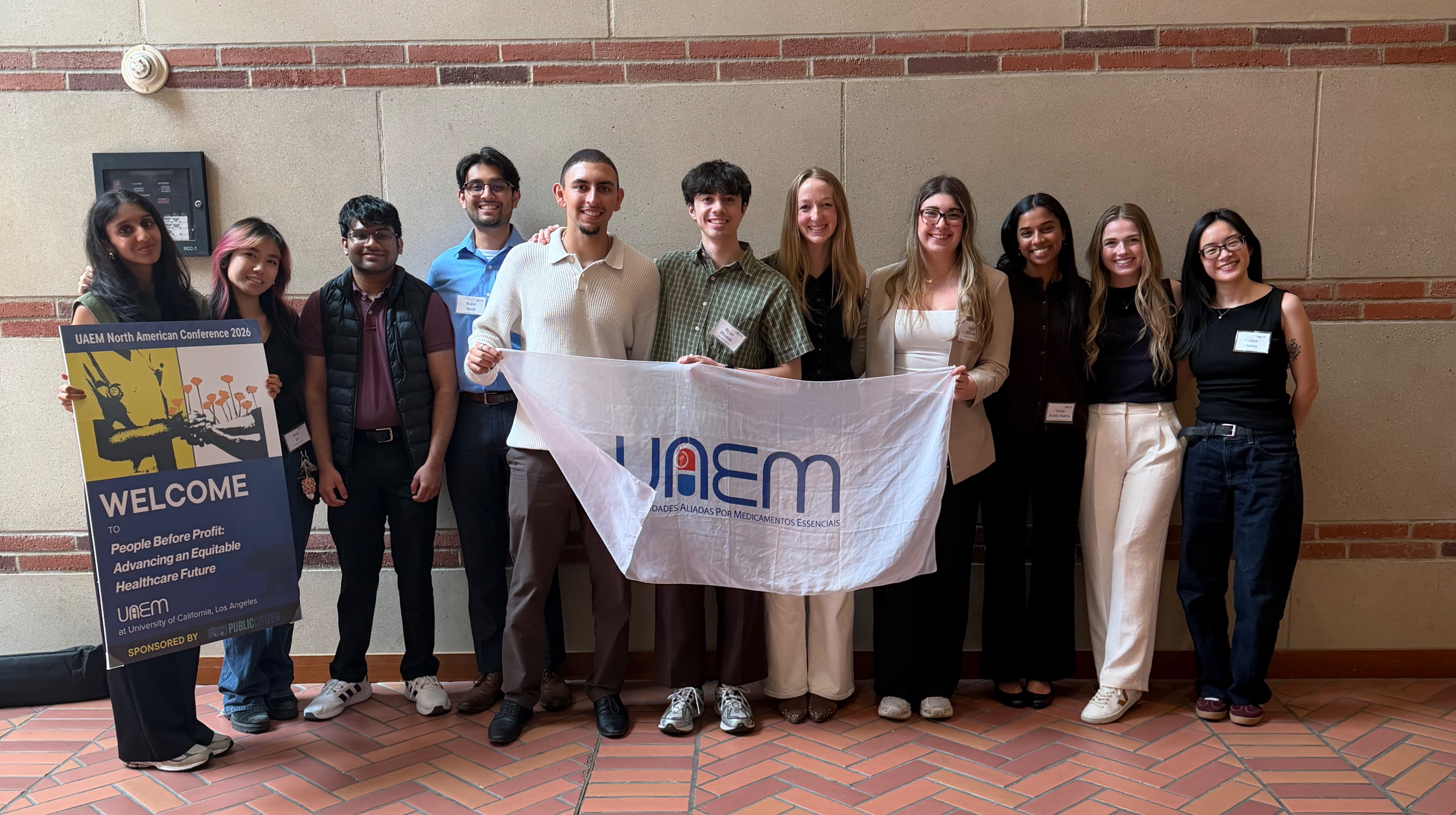
(Above) UAEM at UCLA student leaders stand next to the conference welcome sign at the end of a successful conference weekend.
|
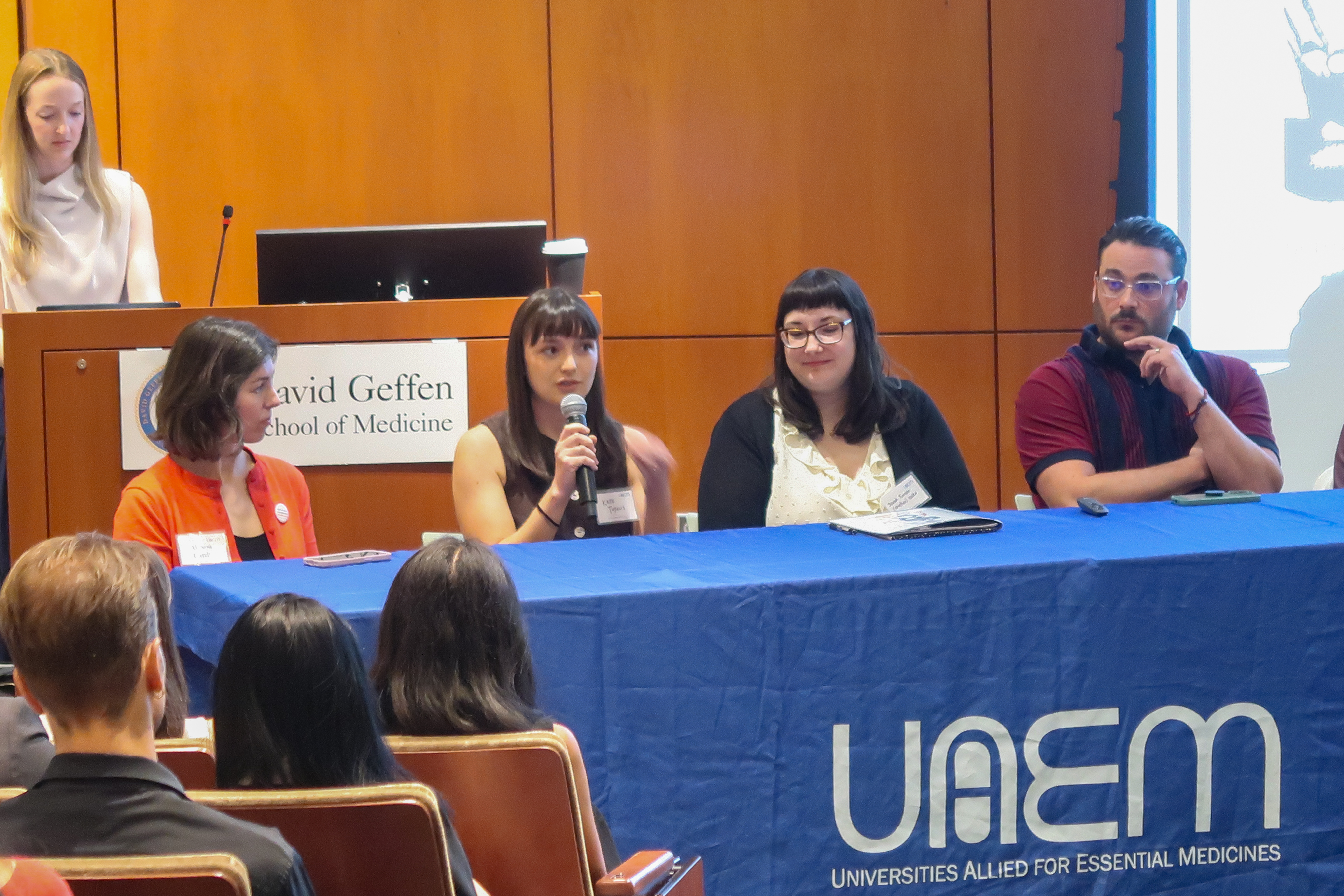
(Above) Public Pharma panelists discuss the role of public manufacturing of insulin in ensuring equitable access.
|
The 2026 conference was a reminder that access to medicines is more than a question of science or innovation, but, rather, one of power: who funds research, who controls knowledge, who sets prices, and who ultimately benefits from publicly supported discoveries. At a moment when research funding is under threat and global health systems reflect deep inequities, UAEM's work feels especially urgent. This weekend showed that students, more than being future advocates, researchers, or policymakers, are already actively shaping the conversation, building coalitions, and challenging institutions to serve the public good.
|
UAEM’s 2026-2030 International Strategic Plan
|
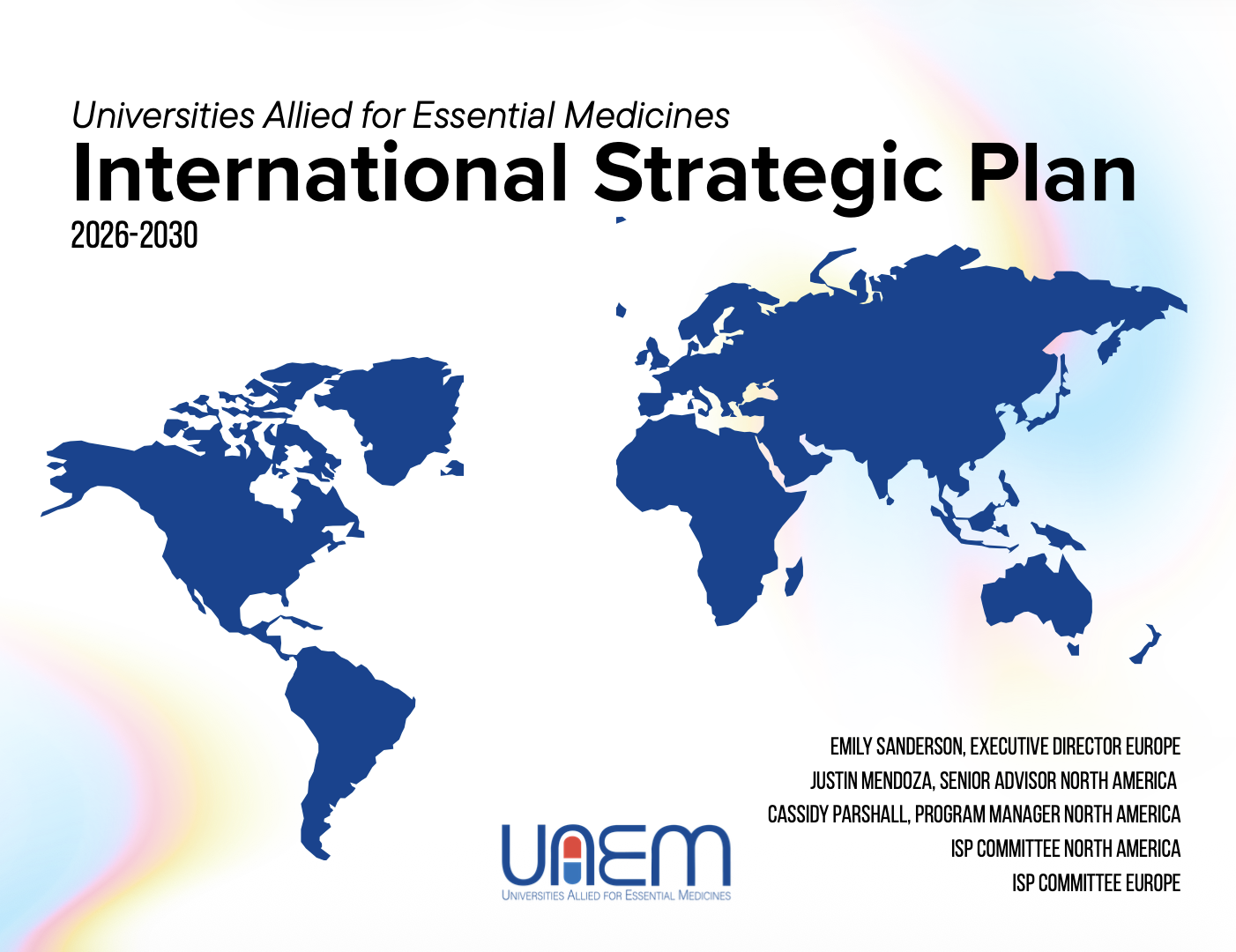
This spring, UAEM launched the 2026-2030 International Strategic Plan: UAEM’s strategy and direction for the next five years. Organized around three pillars – Power, Access, and Inclusive Innovation – the ISP outlines how we will bring our mission and vision to life.
|
Lenacapavir: the HIV Breakthrough Proving Why NIH Funding Matters
Think Global Health, June 9, 2026
NIH research grant funding has been invaluable in the development of numerous medical technologies to treat and prevent diseases. One prime example is lenacapavir, a twice-yearly injection that prevents nearly all new HIV infections. Through the lens of lenacapavir, Rahil Modi, UAEM Access Leader, outlines the critical importance of NIH funding.
Universities Allied for Essential Medicines advocates for affordable health care
Daily Bruin, April 12, 2026
“Universities Allied for Essential Medicines, an international advocacy organization that has chapters at universities including UCLA, raised awareness about medication unaffordability during its annual North American conference at the Neuroscience Research Building from April 3 to 5. Aashi Jhawer, the president of UAEM UCLA, said the conference’s theme – “People before Profit” – aimed to draw attention to rising drug prices.”
US GAO march-in rule analysis angers both sides of debate
MLex, March 5, 2026
“Cassidy Parshall, program manager of Universities Allied for Essential Medicines, told MLex that considering price in march-in authority is “an important, underutilized tool” to combat the “price gouging” of prescription drugs.”
|
UAEM teams up with organizations and experts around the world to demand meaningful change. When we all come together, even the most powerful governments and pharmaceutical companies listen.
|
Ensuring Equitable Global Access to MK-8527 for HIV Prevention February 11, 2026 UAEM, Health GAP, and 175 other organizations call Merck’s Chairman and CEO, Robert M. Davis, to develop a meaningful global access strategy for MK-8527, a promising HIV prevention pill now in clinical trials.
|
Principles for Access to Medicines and Trade February 23, 2026 UAEM and more than 100 organizations outline principles for access to medicines and trade that urge countries to reject the Trump administration’s attacks and commit to global trade policy that protects access to affordable medicines.
|
Support the ETHIC Act April 14, 2026 UAEM, T1 International, Treatment Action Group, and 20+ organizations and experts voice their support for the ETHIC Act to combat pharmaceutical monopoly abuse by curbing patent thickets.
|
USG Must Commit to a Rapid and Equitable Ebola Response June 16, 2026 UAEM joins Public Citizen and eight other advocacy organizations in demanding the U.S. government commits to a rapid and equitable Ebola response.
|
A Public Option for Broader Equity
|
March 5, 2026 By: UAEM North America Access Team
The pharmaceutical industry exists in a mutually dependent relationship with affluent populations, prioritizing profits over broader accessibility. What value is there in creating life-saving drugs if they remain out of reach from those who need them most? How can we justify millions of preventable deaths from diseases that already have cures? Analyses state that 90 percent of pharmaceutical research and development is directed towards the diseases that affect the wealthiest 10 percent of the global population.[1] This imbalance leaves various disease areas without investment, delaying the development of countermeasures for conditions disproportionately impacting low-income and marginalized communities. And while pharmaceutical companies continue to expand their margins, over 18 million Americans remain unable to afford the medications that they need.[2]
In the United States, private companies have the right to choose where their money is allocated. This begs the question: why should pharmaceutical companies prioritize equity over profits when they choose where to spend their research and development (R&D) dollars? Unknown to many, a large portion of pharmaceutical R&D in the U.S. is funded through tax dollars. In fact, 354 of 356 drugs (99.4%) approved from 2010 to 2019 had received funding from the National Institute of Health (NIH), a total of $187 billion.[3] In practice, public funding often pays for early-stage development and then private companies later set monopoly pricing on it. Additionally, many pharmaceutical therapies for rare or neglected diseases do not make it past early-stage development nor receive robust funding due to their projected lack of return on investment. This bill will provide an avenue to develop such therapeutics that currently don’t have commercial incentives and will maintain downstream affordability as the institute will have control over prices. Ensuring that health care access and pharmaceuticals reach those who need them is imperative; health innovations must reach everyone, not only the privileged few, and public funding should serve public interest.
The Medicines for the People Act, introduced today by Representative Rashida Tlaib, provides a solution to this complex landscape. This revolutionary bill will create a new institution under the NIH for full-cycle research and development, of which is not currently a public option.[4] This will allow the taxpayer-funded NIH money to be directed into high-impact therapies, especially for historically marginalized populations, rather than return-driven ones. Diseases affecting Americans that have long been neglected could be pharmaceutically addressed and the government will be able to maintain their affordable prices. Having a public institute that places public health returns at the forefront of pharmaceutical R&D will lead to a soundly robust public health landscape within the US. This bill also ensures legal technicalities that often lead to downstream problems, such as patents and trade secrets, are managed in a way that is in the interest of the public.[4] Taken together, the Medicines for the People Act is a sustainable solution that will redefine the pharmaceutical industry to improve American public health for generations to come.
There is a place for the private pharmaceutical industry; there is no place for it to hold an oligopoly. Through this industry-redefining bill, America can develop the technologies that are needed most to protect our people, gaps which may never be addressed through the private industry alone.
Read more about the Medicines for the People Act.
References
- Joseph E. Stiglitz and Arjun Jayadev, “Medicine for Tomorrow: Some Alternative Proposals to Promote Socially Beneficial Research and Development in Pharmaceuticals,” Journal of Generic Medicines 7, no. 3 (2010): 217–226, https://doi.org/10.1057/jgm.2010.21
- Albert Wertheimer, “18 Million in the USA Cannot Afford Needed Drugs,” Journal of Pharmaceutical Health Services Research 12, no. 4 (November 2021): 473, https://doi.org/10.1093/jphsr/rmab065
- Ekaterina Galkina Cleary, Matthew J. Jackson, Edward W. Zhou, and Fred D. Ledley, “Comparison of Research Spending on New Drug Approvals by the National Institutes of Health vs the Pharmaceutical Industry, 2010–2019,” JAMA Health Forum 4, no. 4 (April 28, 2023): e230511, https://doi.org/10.1001/jamahealthforum.2023.0511
- Tlaib, R. [Office of U.S. Rep. Rashida Tlaib]. (2025). The Medicines for the People Act [Policy brief]. U.S. House of Representatives.
|
(Above) UAEM Coordinating Committee members pose with a UAEM flag.
|
Excited about the work UAEM is doing? Support us further by contributing to our mission of advocating for equitable access to medicines for all.
|
|